
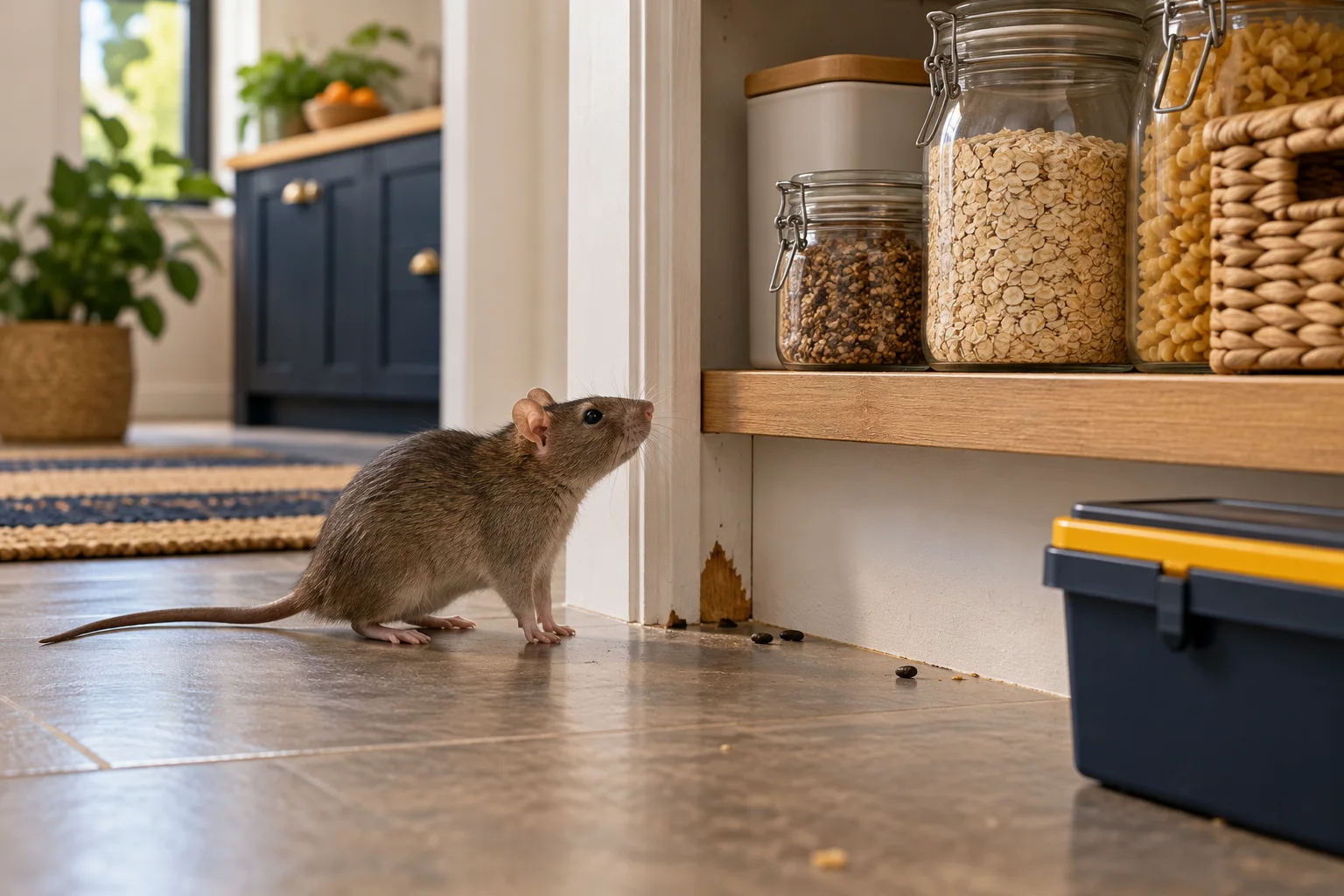
AI-generated illustration
One sighting is evidence, not a headcount
Seeing one rat means at least one rat used that location. It does not prove there are ten, fifty, or a nest of young hidden nearby. Rats can travel for food, and an animal seen outdoors may not be living on the property. At the same time, a single indoor sighting should not be ignored because it shows that a building route, food source, or shelter condition may be available. The useful response is inspection, not a guessed population number.
Write down the time, exact location, and what the rat was doing. Was it near garbage, a pet bowl, a fruit tree, a garage door, an attic vent, or a wall opening? Look for fresh droppings, gnaw marks, nesting material, rub marks, tracks, food damage, or a burrow. Photographs and a simple map turn a brief sighting into information you can use. Do not try to catch the animal by hand or chase it into another room.
Fresh signs show current use
Droppings found after a safe cleanup, new gnawing, bait taken from an unset trap, repeated sounds, or a rat seen on the same route over several nights suggest continuing activity. CDC says a week without new signs or captures is a useful indication that a rat problem has ended; the reverse is also useful—fresh evidence after cleaning indicates the route is still in use. This is more reliable than trying to infer population size from how large or bold one rat looked.
Do not count old droppings as current animals. CDC warns against sweeping or vacuuming rodent waste dry. Wet it with disinfectant, allow the proper contact time, then wipe it up and monitor the clean location. If new waste appears, document where. A small amount of fresh evidence in several separated areas may matter more than a large old accumulation in one forgotten corner.
Food and shelter can support more activity
Rats establish more easily where food, water, shelter, and access are available. UC IPM lists garbage, animal feed, pet food, fallen fruit, dense vegetation, and stored clutter among the conditions that matter. An open bag of feed or regular curbside food waste can support more than a passing animal. A dense hedge, woodpile, garage, or attic can provide cover. Remove these conditions even if you have only seen one rat.
The species can affect where you look. Roof rats may use elevated vegetation and attic routes; Norway rats may use burrows and lower-level gaps. Do not make a species diagnosis from the number seen. Inspect the whole route from outdoor cover to the building envelope. A property can have a single visitor, a small established group, or activity that originates nearby; each still benefits from reducing food and closing access.
Trap based on evidence, not fear
For confirmed indoor activity, CDC recommends rat-sized traditional snap traps in protected, accessible routes where signs appear. A rat can be wary of unfamiliar equipment, so CDC suggests pre-baiting an unset trap until bait is taken. Check traps daily and keep them away from children and pets. Do not place a large number of traps randomly around a room because one rat was seen in a different part of the house. Placement should follow the evidence map.
CDC advises against glue and live traps because trapped rodents may become frightened and urinate. Do not scatter poison because you believe one sighting guarantees a huge hidden population. If a persistent infestation requires a pesticide decision, use a labeled EPA-registered bait station in a protected setting or consult a professional. A calm, monitored plan gives more useful information than an escalating collection of products.
Inspect and repair before assuming success
A caught rat is useful evidence, but it does not close the entry point. Inspect doors, garage seals, crawl-space panels, vents, utility gaps, eaves, and roofline features. UC IPM warns that rats can chew foam, plastic, wood, and caulk, so use durable materials appropriate to the feature. Do not block required drains, vents, or appliances. If an active route is still in use, time final sealing after the removal stage to avoid trapping animals inside.
Secure food and garbage, clean spills, pick up fallen fruit, and reduce dense cover near walls. These steps give a rat less reason to return and make fresh signs easier to see. Recheck the original sighting location for a week. If there are no new signs or captures, keep the maintenance routine. If evidence returns, do not assume failure; revisit the route and look for a missed food source or opening.
Call for help when the evidence is complex
A professional inspection is useful when signs are in an attic, wall, duct, crawl space, roofline, or shared building; when contamination is heavy; or when wires, plumbing, or structural features may be damaged. Ask the professional what evidence supports its assessment and how it will distinguish a passing visitor from an established route. A good answer includes inspection, removal, exclusion, and follow-up, not only a product placement.
One rat can be the beginning of a problem, but it can also be the first clue that lets you prevent one. Avoid both extremes: do not dismiss it, and do not invent a population size. Use the sighting to inspect, reduce resources, remove any confirmed indoor activity safely, and repair the path that gave the animal access.