
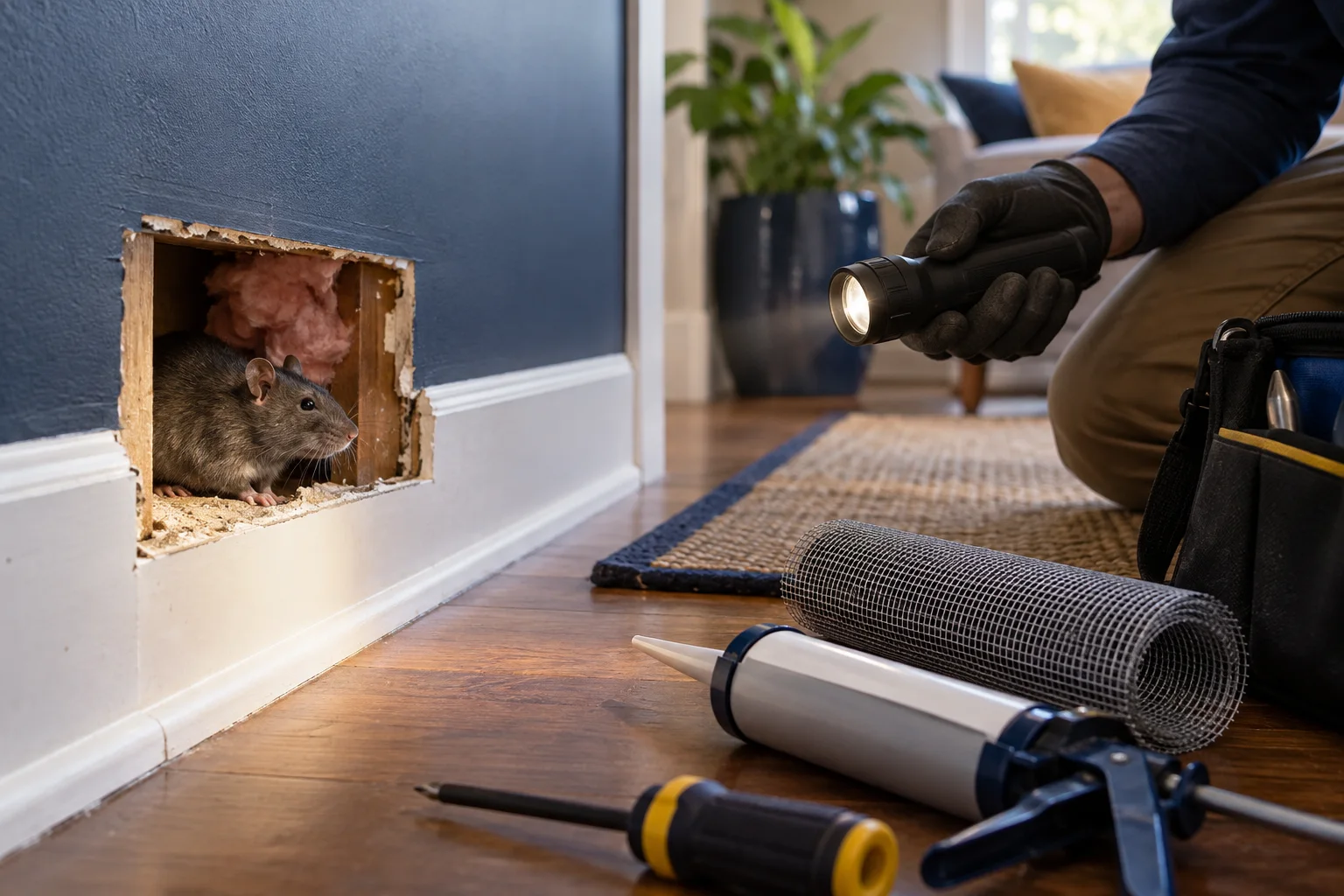
AI-generated illustration
Wall noises need evidence before demolition
Scratching, scurrying, or a brief thump inside a wall can come from several animals and from building systems that change as temperatures change. A rat is possible, especially when the sound coincides with droppings, gnaw marks, a damaged vent, or activity near a known entry point. But cutting open drywall based on one noisy night often creates a repair without solving the route. Begin by documenting when and where the sound occurs, whether it is near an exterior wall, and what signs appear around the house.
Roof rats may favor walls, attic spaces, false ceilings, and other elevated voids, while Norway rats commonly begin lower in a building, according to UC IPM. Those are clues, not guarantees. A rat can travel through a void in either direction. The most useful investigation follows the exterior toward the interior: food and cover in the yard, an opening in the building envelope, then the wall or ceiling area where evidence appears.
Inspect the outside before the cavity
Walk the exterior slowly in daylight. Check the foundation, door bottoms, crawl-space vents, exterior corners, utility penetrations, drain and pipe openings, siding transitions, eaves, and roofline. Look for gaps, chewed edges, greasy rub marks, droppings in protected places, or disturbed insulation near an access panel. Also trace vines, fences, stacked materials, downspouts, cables, and tree limbs that may give a climbing species a route to an upper-wall opening.
Use photos and mark the locations on a simple sketch of the house. It is easier to compare evidence after a repair when you know exactly which side of the garage or which corner of an eave was involved. Avoid poking wire or foam into an opening you have not identified. It may be a drain, a weep hole, a vent, or a protected building function. If a gap is near wiring, gas piping, HVAC equipment, or an inaccessible roof edge, arrange for the appropriate professional to inspect it.
Do not seal an occupied wall blindly
Exclusion is the durable answer to a rodent entry point, but timing matters. Sealing every hole while a rat is still using an interior void can leave it trapped inside, driving it to chew at another area or die in an inaccessible space. First establish whether activity is current. Fresh droppings, new gnawing, bait taken from a pre-baited trap, or repeated sounds in the same route are more meaningful than old stains or a long-faded odor.
If there is active indoor activity, use a removal plan that accounts for the suspected route. CDC recommends inspecting for how rodents got in and setting traps for those that remain. An experienced exclusion professional can decide when and how to close a confirmed route after removal. One-way devices may be appropriate in certain situations, but their use needs careful inspection, species awareness, and a plan for every other opening. Do not improvise a one-way exit from cardboard or mesh in a wall cavity.
Use traps where the rat actually travels
Traditional rat-sized snap traps are CDC's recommended option for reducing rodent populations around the home. Place traps based on evidence: beside a wall in a protected service area, behind an appliance, inside an accessible attic or crawl space, or in another established runway. CDC recommends placing the baited end close to the wall so the trap forms a T with it. Keep every trap and bait inaccessible to children and pets, and read the manufacturer's instructions before setting it.
Rats are cautious around unfamiliar objects. Pre-baiting an unset trap for a short period can show whether the animal is using that route; when bait has been taken, set the trap. Do not put traps loose inside a sealed wall, where you cannot check them daily or remove a catch promptly. CDC advises against glue and live traps because a frightened trapped rodent may urinate, increasing exposure risk. In a hard-to-reach cavity, professional access and placement are safer than a hidden device you cannot monitor.
Open a wall only when the evidence supports it
A small, planned access opening can be worthwhile when there is a trapped carcass, confirmed contaminated nesting material, damaged electrical insulation, or activity that cannot be reached from an attic, crawl space, basement, or removable panel. Before any cut, turn a vague suspicion into a specific location using inspection, photographs, and professional judgement. Check for plumbing, wiring, and structural features. Repairing a small access opening is simpler than fixing a blind cut through a pipe or cable.
If material inside the wall must be cleaned, do not dry-vacuum it. CDC's cleanup guidance calls for wetting droppings and nests with disinfectant, allowing the correct contact time, and picking them up with paper towels or the appropriate removal method. Extensive contamination, wet insulation, electrical damage, or HVAC involvement can require more than pest control. Coordinate the work so removal, cleanup, and repair happen in the right order rather than reopening the wall after it has been patched.
Repair the actual route and protect building functions
Once there is no active interior activity, repair verified exterior gaps with materials a rat cannot readily chew through. UC IPM recommends sealing cracks and openings and notes that rats can defeat plastic, foam, wood, and caulk. Fitted metal, wire screening of an appropriate gauge, flashing, and sound building repairs are common solutions, depending on the feature. A door gap calls for a proper sweep; a utility penetration needs a fitted seal; a damaged vent needs a screen that preserves airflow.
Do not plug drainage openings, combustion vents, dryer exhausts, or other necessary ventilation blindly. Details at roof and wall interfaces may need a roofer, HVAC technician, plumber, or electrician. Good rodent exclusion respects the building's job as well as the rat's ability to gnaw and climb. Ask the person doing the repair to explain why the material is suitable, how water will drain, and how the work will be checked after a storm or seasonal movement.
Prevent the next wall problem
Rats return to places that remain easy to reach and rewarding to use. Keep trash lidded, store feed and dry food securely, collect fallen fruit, and clean food residue from outdoor areas. Thin dense vegetation close to the structure and move stored materials away from the wall so inspection remains possible. If a roof-rat route was involved, prune limb and vine connections that let an animal reach the eaves or upper wall without crossing open ground.
Recheck the repaired area after a week, then after rain, wind, or exterior work that could loosen a screen or seal. Look for new gnawing, disturbed patch material, fresh droppings in a sheltered space, or repeat sounds in the same location. If evidence persists, do not keep opening different parts of the wall. Reassess the outside route and have an experienced professional locate the missed entry. A wall becomes quiet for good when the exterior path is closed and the nearby food and cover are reduced.