
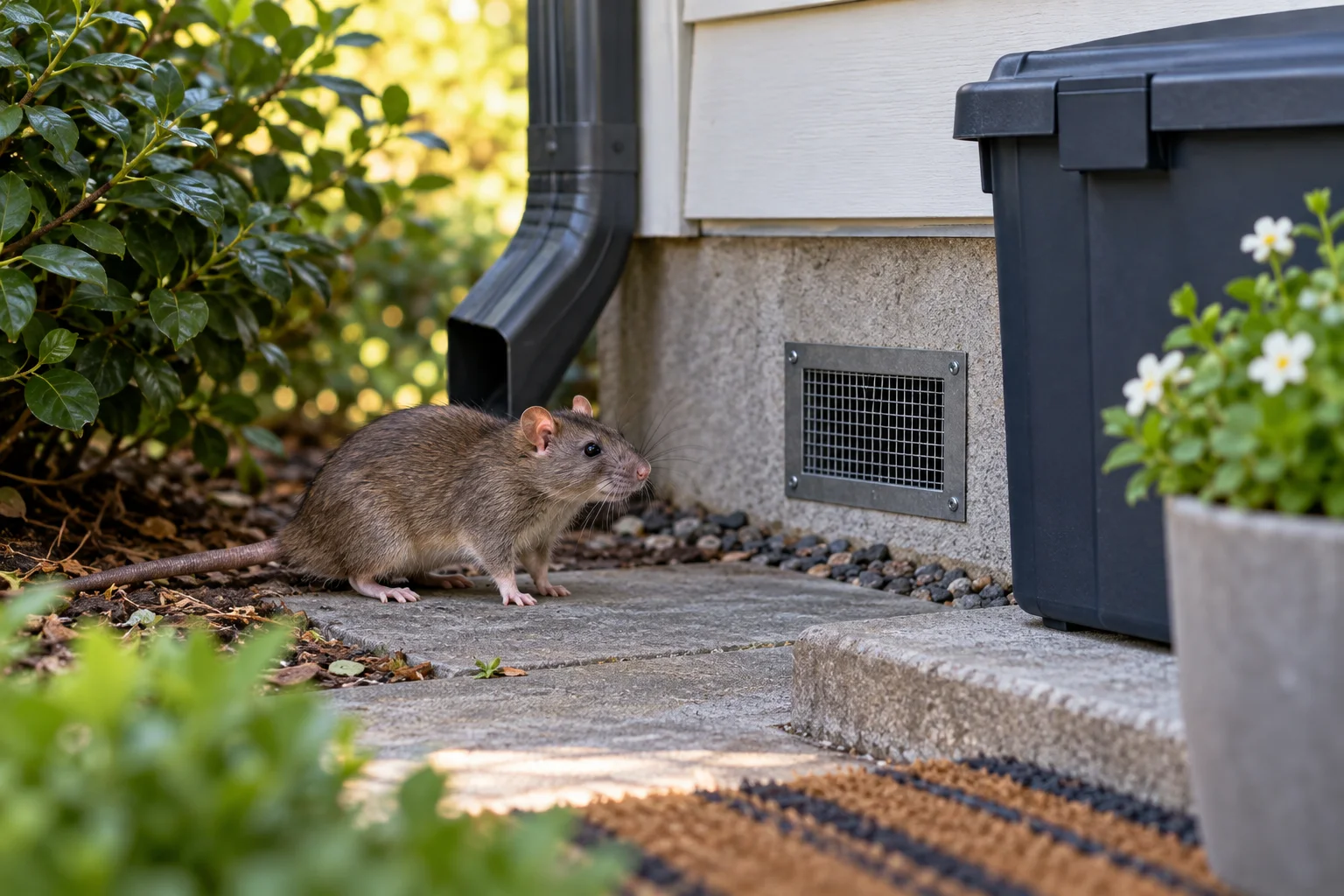
AI-generated illustration
A startled rat may leave the view, not the property
Rats are wary of unfamiliar sights, sounds, and movement. A person entering a garage, a dog barking, or a new light can make a rat retreat quickly. That moment is real, but it only shows that the animal moved away from the immediate disturbance. It does not show it left the building, abandoned its nest, or lost access to food and water. A rat can wait in a wall, under a deck, or behind storage until the source of disturbance becomes routine.
That difference explains many reports that a device worked for a night and failed a week later. The homeowner observed an interruption in visible behavior, then expected population control. An unfamiliar event can interrupt a runway. Lasting control requires changing the reasons the runway is useful. UC IPM describes rats as readily frightened by strange noises but says they quickly become accustomed to repeated sound. The same learning problem affects lights, moving objects, and repeatedly placed decoys.
Habituation is the key limitation
Habituation means a repeated, harmless stimulus gradually gets less attention. A sound that does not create danger, remove shelter, or block a route becomes background. This is why a radio in an attic, a motion ornament in a garden, or a high-frequency device should not be treated as a barrier. The rat does not need to enjoy the stimulus; it only needs to learn that food, nesting space, and a safe exit are still available.
UC IPM specifically finds frightening devices, including high-frequency and ultrasonic sounds, ineffective for controlling rats in homes and gardens. That is stronger and more useful than arguments about whether an individual rat can hear a frequency. Even a sound an animal detects may not reach behind furniture or into a wall cavity, and it can lose relevance when it produces no consequence. Do not spend days moving one noise maker around while new evidence accumulates elsewhere.
Use a brief disturbance as an inspection opportunity
A temporary scare can still have one limited value: it may reveal a direction of travel. From a safe distance, notice whether an animal runs along a fence, climbs a vine, disappears behind an appliance, or enters a gap near a pipe. Do not chase, corner, strike, or handle it. Give the animal space and keep children and pets away. A route observation is more useful than trying to force a confrontation.
Write down the location, time, and direction, then inspect that route in daylight. Look for droppings, rub marks, gnawing, gaps, branches meeting a roofline, or a food source that supports the route. The next step is not to recreate the scare every evening. It is to make the route less functional through sanitation, access repair, and appropriate control. The observation turns a surprising encounter into a practical clue.
Avoid methods that create a larger hazard
Never try to drive rats out with smoke, exhaust, flooding, fire, or chemicals in an enclosed building, wall, burrow, or drain. These methods can harm people, pets, and property while leaving alternate routes untouched. UC IPM warns against smoke and gas cartridges around homes because burrows may extend beneath a residence and toxic gases can enter the dwelling; it also notes associated fire hazards. Vehicle exhaust is not a home pest-control tool.
Do not rely on a pet to solve the problem either. A cat or dog can cause rats to become less visible without ending their access to hidden shelter. It can also bring a pet into contact with a cornered animal, toxic bait, or a carcass. If a rat is trapped in a living area or there is an immediate safety issue, isolate the room where possible and obtain appropriate local assistance. For routine activity, calm evidence gathering is safer and more informative than escalating the disturbance.
What actually makes returning harder
Rats return when the place still offers a route, cover, food, water, or a nest site. Outdoor measures can include managing fallen fruit, tightly closing garbage, avoiding all-night pet feeding, and reducing dense cover against the building. Indoor measures can include protected food storage and repair of gaps at doors, utility penetrations, and damaged screening. Which measure matters most depends on the signs you found; there is no single noise or scent that substitutes for inspection.
Where rats are already active, use a control method appropriate to the location and keep it inaccessible to children and pets. UC IPM identifies snap traps as a safe, effective, economical approach when used correctly. A trap program should be located from actual signs and checked regularly, not scattered at random after a scare. Once activity is addressed, sealing remaining access makes the change durable.
Measure results by signs, not silence
A quiet night is not a reliable result. Rats may change their schedule, travel inside a void, or avoid a newly disturbed room. Check for fresh droppings, food disturbance, new gnawing, active burrows, or use of a known route. Compare those observations with the baseline from before you began. This gives you a way to tell whether a change is reducing activity or merely moving it out of sight.
Scaring is best understood as a momentary behavior, not an eradication strategy. It can reveal where to look, and it can keep an animal from an exposed area briefly. It cannot repair a hole, remove a nest, or make repeated sound meaningful to a rat that still has shelter and food. Put the attention on the evidence the startle revealed.