
AI-generated illustration
Start a clear record before the evidence disappears
A renter does not need to solve the legal question before reporting rats. Start with a factual record: the date and time, room or exterior location, what was seen, and a photo or short video where it can be taken safely. Include associated conditions such as droppings beside a pet-food container, a gap under a door, a gnawed cabinet opening, a burrow by a foundation, or noise in a ceiling. Avoid touching droppings just to make the report more convincing.
Keep the record neutral. “Fresh-looking droppings found behind the stove on Tuesday” is more useful than a conclusion about a disease or a claim that the owner caused an infestation. If a repair request has already been made, save the request, response, appointment notice, and follow-up. A simple timeline lets a property manager see patterns across units and gives the renter something concrete to use if the issue persists.
Give written notice with a workable request
Report the issue promptly through the channel named in the lease or building rules, and keep a copy. State the evidence, location, access hours, and whether there is an immediate concern such as exposed food, a chewed electrical cord, a child’s sleeping area, or a failed exterior door. Ask for an inspection and for the report or next step in writing. A request that identifies the exact area is easier to act on than “there are rats somewhere.”
Do not wait for a species-level identification to make the report. Management may need to inspect adjoining units, common garbage areas, rooflines, utility chases, or the building exterior. Ask when the inspection is scheduled and what entry preparation is needed. If treatment is proposed, ask for the instructions that apply to residents, children, pets, food, and access. Follow reasonable entry procedures while preserving the written record of what occurred.
Know that responsibility is local and fact-specific
Who must arrange pest control, repair an opening, prepare a unit, or pay for a service depends on the lease, the facts, and state or local law. HUD notes that landlord-tenant laws vary by state, and local housing or health codes can add rules. A website cannot decide responsibility for a specific apartment, duplex, or subsidized property. Read the lease sections on maintenance, notice, access, sanitation, and pests alongside the current guidance from the relevant local agency.
That limitation protects both renter and landlord from assumptions. An entry point in shared structure may require building work; food stored open in a unit may require a tenant-side change; both conditions can exist at once. Do not withhold rent, deduct repair costs, deny access, move out, or make structural alterations based only on general online advice. When the response is disputed or delayed, get local tenant, housing, or legal information that applies to the property and jurisdiction.
Clean safely while the source is being addressed
Do not sweep or vacuum dry droppings, urine, or nests. CDC directs residents to wear gloves, wet the material with disinfectant or its bleach solution, allow the recommended contact time, wipe it up with paper towels, and clean the affected hard surface. This protects the household while the source is being investigated. It does not replace building repair, because cleaning an area repeatedly while activity continues leaves the underlying route and shelter intact.
Protect food rather than merely moving it to another open shelf. Discard food with evidence of contamination, clean hard containers, and store food and pet feed in rodent-resistant containers as appropriate. Keep children and pets away from traps, droppings, bait stations, and any treated area. If the unit has heavy contamination, inaccessible voids, a contaminated HVAC area, or a dead animal that cannot be reached safely, report that scope specifically instead of opening walls or ducts yourself.
Make the inspection useful
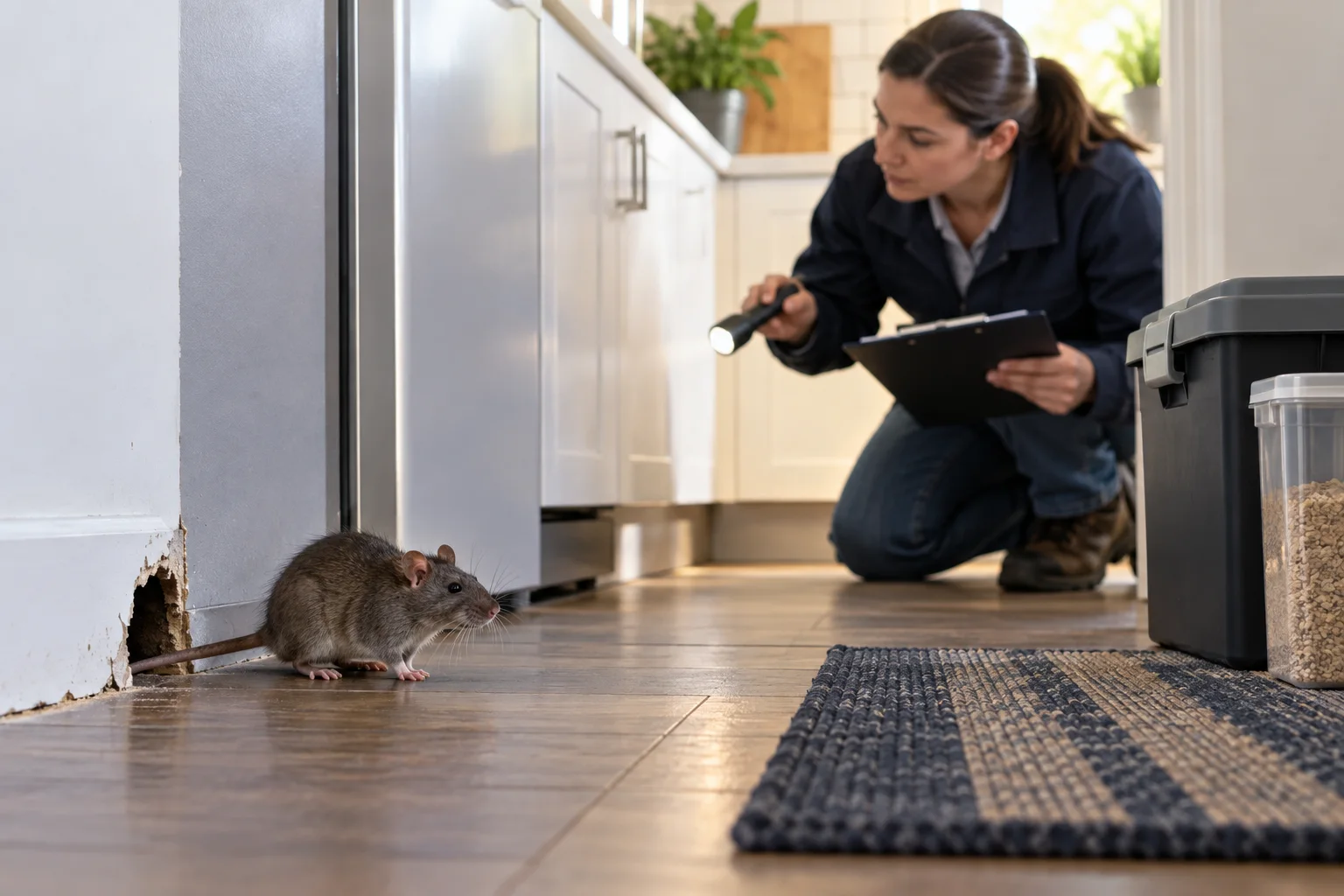
Walk through the unit with a consistent list: entry doors and sweeps, windows and screens, pipe penetrations under sinks, gaps behind appliances, vents, shared utility openings, exterior refuse areas, and landscaping or clutter against the building. Photograph defects without damaging them. Note whether signs are low and near burrows or higher in cabinets, ceilings, or exterior climbing routes. This helps distinguish a one-room sanitation issue from a building-envelope issue.
Keep personal measures reversible unless the lease and property manager authorize more. You can keep food sealed, reduce clutter, and clean safely. Do not plug an active opening from the inside if you do not know whether an animal is trapped beyond it, and do not install poison, foam, or wiring changes in shared cavities. A coordinated inspection can choose an order that addresses animals in the structure before final repairs close the route.
Escalate based on conditions, not frustration
If the first report does not resolve the signs, send a concise follow-up with the new dates, photos, and the earlier request number. Ask what inspection or repair remains and by when. If there is an urgent hazard, use the emergency maintenance path stated by the property. For unresolved habitability or code concerns, the appropriate local housing, health, tenant-support, or legal resource depends on where the rental is located and on the type of housing.
A good record supports a practical outcome: identify current activity, clean it safely, repair access, and verify that signs stop. It also prevents a renter from having to repeat the whole story every time the issue changes hands. The aim is an effective building response and a safe household, not a generic declaration of who is always at fault.