
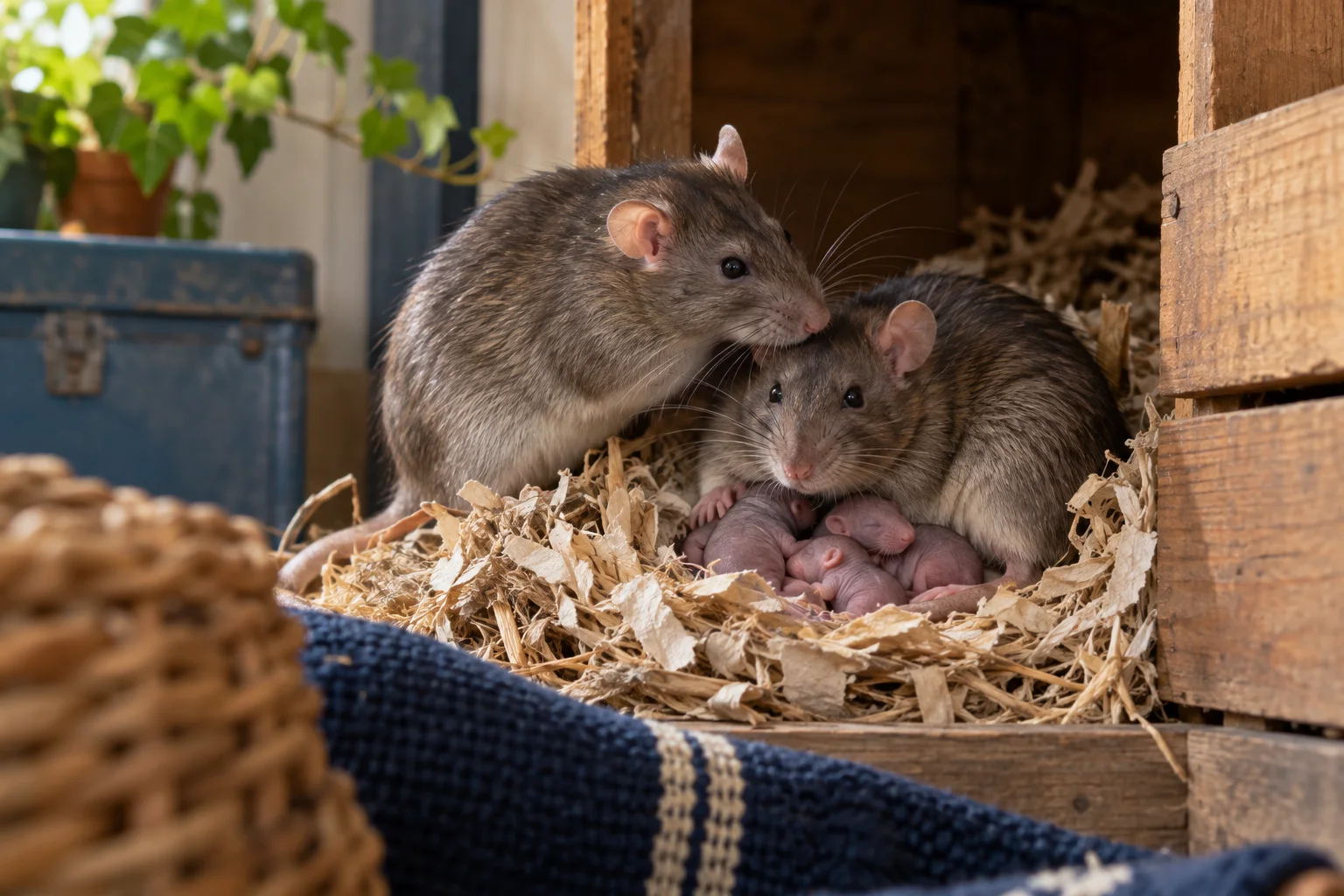
AI-generated illustration
Reproduction follows resources
Rats can reproduce repeatedly when food, water, shelter, and safe nesting space are available. That does not mean every sighting becomes an immediate large infestation, but it is why waiting for a problem to disappear can be costly. UC IPM reports that roof rats average three to five litters a year with up to eight offspring per litter, while Norway rats average four to six litters a year and can wean twenty or more offspring annually. Local conditions and survival vary.
The homeowner does not need to identify a pregnant rat or find a litter to act. Fresh droppings, nesting material, gnawing, food damage, and a route into a building are enough reason to inspect. A nest of shredded insulation or paper can indicate shelter, but it does not tell you exactly how many animals are present. Avoid opening a wall or pulling apart a nest as a way to count them; focus on removal and the entry path.
Protected nest sites matter most
Roof rats may nest in attics, wall voids, ceiling spaces, cabinets, trees, and dense vegetation. Norway rats may use burrows beneath foundations, trash piles, woodpiles, and gardens, while also entering lower building areas. These tendencies guide inspection: look high when evidence is in an attic or eave, and look low around garbage, vegetation, and foundation defects when burrows appear. The species patterns can overlap at the same property.
A nest becomes possible when the route stays open and the site stays undisturbed. Remove food and cover near the building, clear cardboard and loose material from garages, store belongings in sealed containers, and repair accessible defects. Do not seal an active nest route before removal is planned; animals may remain inside a wall or attic and create another problem. A professional can assess difficult or inaccessible nesting sites.
Season is not a reliable safeguard
Breeding patterns can vary by location, species, food supply, shelter, and climate. A homeowner should not assume that winter, summer, a cold spell, or a hot attic will prevent reproduction. Buildings can buffer weather and provide stable nesting conditions. Seasonal changes may alter where rats travel, but they do not replace sanitation and exclusion. Check the property whenever new food, clutter, roof damage, or storage changes create a resource.
This is also why one caught rat should not be read as proof of a large hidden population or proof that there is only one. Use evidence: fresh droppings after cleaning, repeated bait removal from an unset trap, multiple nesting sites, new gnawing, or a clear nighttime route. Keep a short log. It gives a professional a basis for estimating activity without relying on dramatic reproduction claims.
Early action reduces the chance to establish
UC IPM says less time and effort are required when rat numbers are low, and fewer traps and less toxic bait may be needed when measures start early. When you find evidence, secure food and garbage, remove outdoor pet food, pick up fallen fruit, reduce dense cover, and inspect likely entry points. These actions reduce both survival and the chance that a protected nesting site remains attractive.
For confirmed indoor activity, CDC recommends traditional rat-sized snap traps in protected routes where signs are present. Rats may be cautious around new equipment, so pre-baiting an unset trap can help show whether the route is active. Check traps daily and do not use glue or live traps. In a wall, roofline, duct, or inaccessible attic, professional removal is safer than leaving equipment where it cannot be monitored.
Exclude after the removal phase
Once evidence shows no remaining activity, complete durable repairs around doors, vents, eaves, rooflines, crawl spaces, garage edges, and utility penetrations. UC IPM warns that rats can chew foam, plastic, wood, and caulk, so use materials appropriate to the feature. Do not block functional vents, drains, or appliance exhaust. Repair work should preserve the building's safety and prevent the next animal from reaching the same nest area.
A week with no captures or fresh signs is a useful CDC milestone. Reinspect after storms, roof work, seasonal storage, and landscaping changes. Reproduction biology explains why a continuing open route matters, but it does not make an infestation inevitable. A maintained building and reduced food source make it harder for rats to settle, nest, and raise young in the first place.
Avoid myths about killing a litter
Do not pour chemicals into a suspected nest, use smoke, or rely on a pet to clear a wall. These responses can harm people, pets, wildlife, and building systems while leaving the route intact. A live-capture decision can also be complicated by local rules and release restrictions. Use a controlled plan that identifies the species where possible, protects non-target animals, and gives you a way to verify when activity has stopped.
If there is a heavy infestation, widespread contaminated nesting material, damaged insulation, or gnawed wiring, coordinate pest removal with cleanup and trade repairs. CDC advises wet cleanup rather than dry sweeping or vacuuming rodent material. The right goal is a property that no longer supports nesting, not a speculative count of how many young might be present. A documented post-repair inspection can confirm that nest material, food damage, and fresh signs have stopped without repeatedly disturbing the old site, creating unnecessary exposure, or reopening a wall.