
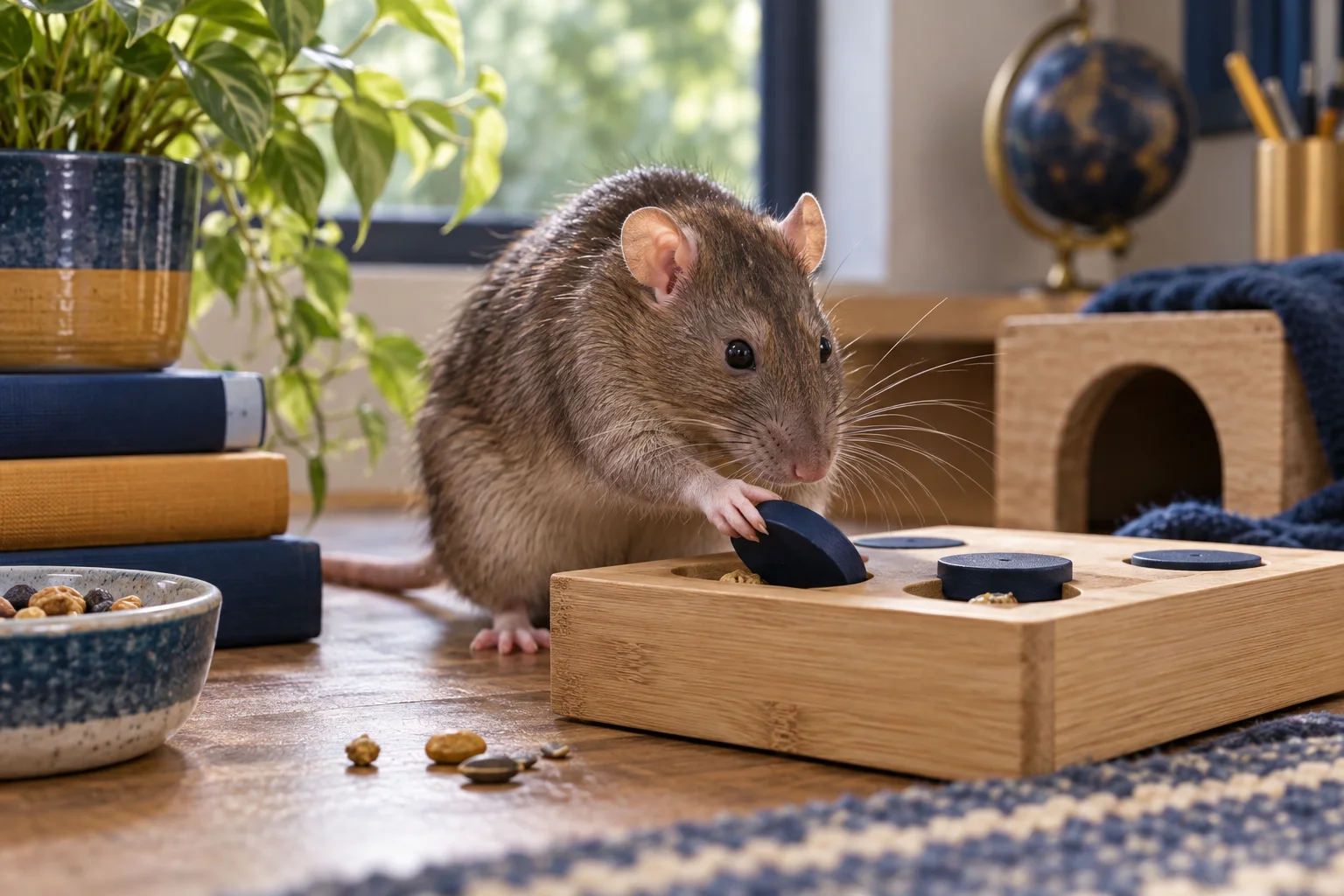
AI-generated illustration
Intelligence is not one trait
When people call a rat smart, they may mean it finds food, returns to a route, solves a puzzle, remembers a place, learns from a bad experience, or recognizes another rat. Those are related but distinct abilities. Scientific research does not assign one universal intelligence number to rats. Instead, it asks focused questions about learning, memory, attention, decision-making, social behavior, or navigation under controlled conditions. A result from one task does not say that every rat in a garage has the same abilities or will behave the same way.
That distinction matters because it prevents two bad conclusions. One is that rats are simple animals that can be controlled with any random object. The other is that a rat is so clever that ordinary prevention cannot work. Rats are adaptable mammals with strong sensory abilities and learning capacity. They still need food, shelter, safety, and routes through their environment. Understanding their learning helps people observe better; it does not turn a rat problem into a contest of human versus animal intelligence.
What laboratory tasks can demonstrate
Researchers study cognition through carefully designed tasks. In spatial-learning experiments, rats may have to locate a platform, choose an arm of a maze, remember which locations have changed, or return to a previously useful place. Other experiments examine conditioning, working memory, attention, social recognition, or response to novelty. The value of these tasks is that researchers can control cues, repeat trials, and compare performance across conditions.
A task result always has boundaries. Performance can depend on sight, smell, body movement, motivation, stress, prior experience, reward value, and the task itself. A rat that learns a route has not necessarily solved a general abstract problem, and a rat that fails a task may have been distracted or unmotivated. Good interpretation says what the experiment measured: for example, spatial memory after experience. It does not convert a maze result into a story about a rat being devious, malicious, or human-like.
Memory and the hippocampus
The hippocampus is important to spatial memory in mammals. In classic rat research, cells in the hippocampus show activity associated with locations an animal occupies. Studies of sleep have also found that patterns of neural firing related to earlier spatial experience can reappear during later sleep. The 1996 work by Skaggs and McNaughton reported replay of firing sequences after spatial exploration. This evidence is useful for understanding memory processing, not for reading a rat’s private thoughts.
The findings explain why researchers use rats to investigate navigation and learning. They do not prove that a rat in a wall is replaying a map of the house or plotting a response to a homeowner. Brain recordings involve particular cells, animals, and settings. A responsible article can say that rats retain and use information about experienced places. It cannot tell a homeowner what a rat remembers from a sound, a dropped crumb, or a single sighting.
Learning from food and routes
A wild rat near a house can learn which areas provide cover and reliable food. It may revisit spilled birdseed, an accessible feed bag, a garbage area, or an opening that leads to a protected void. That is an ecological use of learning, not proof of exceptional cunning. It helps explain why removing a single visible rat without changing the surroundings often fails to produce a lasting result.
Observation should follow the animal’s route rather than a folklore label. Look for physical evidence: fresh droppings, gnawing, nesting material, rub marks, a damaged screen, a door gap, or a pathway through dense cover. UC IPM describes neophobia, or caution around new objects, as especially pronounced in roof rats. That makes unfamiliar equipment or bait placement worth evaluating patiently. It does not justify adding dangerous products or trying to frighten the animal with improvised methods.
Neophobia is a specific behavior
Neophobia means a cautious response to something new. It is not a diagnosis of fearfulness or a personality test. A rat can avoid an unfamiliar object while still returning to the same food source or wall edge. CDC incorporates this behavior into practical guidance by suggesting that a homeowner may pre-bait an unset snap trap until bait is being taken, then set it. The purpose is to make a monitored device less novel, not to train a rat or make assumptions about its mind.
A new item being ignored does not show that there are no rats, and bait disappearance alone does not prove which animal took it. Placement should still be based on documented travel, with traps inaccessible to children and pets and checked daily. If signs continue, reassess the route, food source, and species rather than moving equipment repeatedly. Learning is one part of the animal’s behavior; the condition of the building is often the part a homeowner can change most directly.
What intelligence does not support
Rat cognition research does not support claims that ultrasonic repellers, household fragrances, or a one-time scare will reliably defeat a settled rat. It also does not support chasing an animal to see how it reacts, setting unsafe traps as a challenge, or treating a pet as an intelligence test. A startled animal may bite or run into a less accessible area, while an unaddressed entry hole and food source remain.
For a pet rat, cognitive ability supports the case for species-appropriate social interaction, safe enrichment, and attentive care. For a wild rat in a home, it supports calm, evidence-based inspection. Secure food and garbage, identify access, use a controlled removal method if activity is confirmed, and make a durable repair that preserves any building system’s function. The important lesson is neither that rats are invincible nor that they are simple. They learn from a real environment, and a well-maintained environment gives them far less to learn from.
Use the research with precision
A precise answer to “how smart are rats?” is that rats demonstrate learning and memory across many experimental contexts, especially in spatial and associative tasks, and their behavior changes with previous experience. The exact capacity shown depends on the task, individual animal, and conditions. Researchers continue to study how different brain systems support those abilities.
That answer is more useful than a ranking. It explains why a homeowner should collect evidence rather than assume a rat will enter every new trap, and why a pet owner should provide care that respects a curious, social animal. It also keeps the limits visible: a homeowner cannot infer a rat’s intentions, health, population size, or species from one clever-looking behavior. Those questions need physical evidence and, when necessary, qualified assessment.