
AI-generated illustration
Communication is multimodal
Rats do not communicate through one channel. They use chemical cues, audible and ultrasonic sounds, touch, grooming, movement, posture, and the context of shared space. The mix changes with age, sex, reproductive condition, familiarity, social setting, and immediate circumstances. A rat pup’s contact-related behavior is not the same as an adult’s response during a conflict or a pair’s behavior in a familiar enclosure.
This makes simple translations unreliable. A homeowner cannot listen to a squeak in a wall and know that it means fear, mating, warning, hunger, or a precise number of animals. Scientists identify relationships between signals and contexts by recording behavior repeatedly under controlled conditions. Even then, a call or scent can have more than one possible function. The most accurate description of rat communication is therefore evidence about patterns, not a phrasebook for interpreting one household noise.
Chemical cues and scent marking
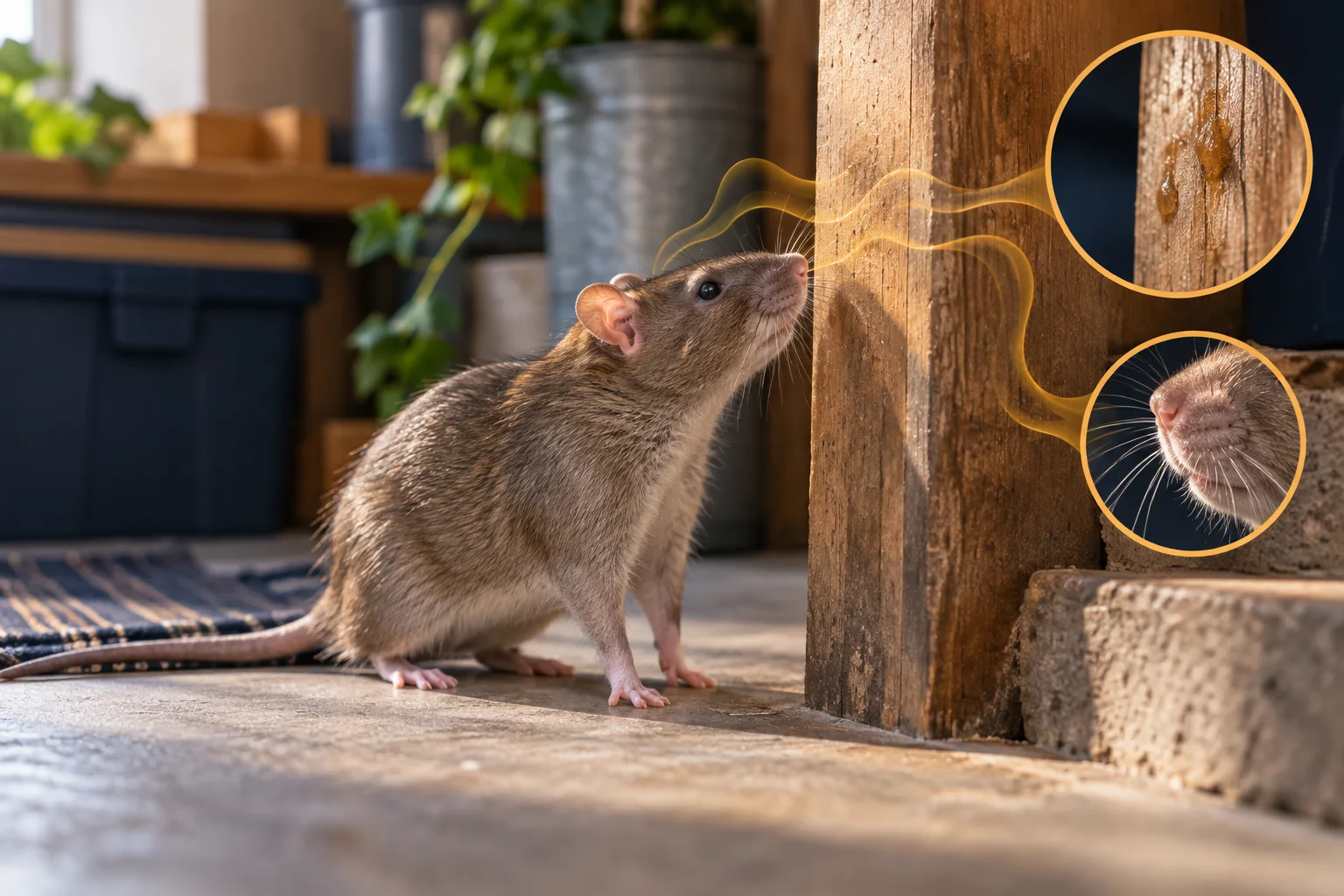
Smell is central to rat behavior. Rats investigate urine, secretions, food odors, bedding, and marks left on surfaces. Chemical cues can contribute to recognition, social and reproductive behavior, route use, and assessment of an environment. Research on Norway rats has found that scent-marking responses can vary with social and reproductive context, including the genetic identity and sex of nearby animals. That is evidence of complex chemical communication, not a guarantee that every odor operates as a simple pheromone switch.
The word pheromone has a technical meaning: a chemical signal that affects another member of the same species. Public discussion often uses it loosely for any animal smell. In rats, some chemical signals and protein-associated odor cues have been studied, but their effects depend on dose, setting, individual history, and the receiver. It is not sound to assume that a commercial fragrance, a predator scent, or a household product will communicate a reliable command to a wild rat.
Ultrasonic vocalizations
Rats produce vocalizations beyond the range people usually hear. Researchers often discuss broad groups around 22 kHz and 50 kHz, but those labels are shorthand rather than two words in a language. Calls differ in duration, frequency shape, timing, and social context. Research has associated 22-kHz calls with aversive or defensive situations and many 50-kHz calls with positive or affiliative contexts, yet the association is not a universal emotional decoder.
Playback experiments provide important evidence because they test the receiver rather than only recording the caller. A 2016 protocol paper summarized results in which natural 50-kHz playback produced social approach in rats, supporting an affiliative or contact-call role in that setting. Another study found that high-frequency calls were linked with locomotion and social context. These results show that sound can affect rat behavior. They do not mean an audible noise in a house can be identified by ear or that a consumer sound device will remove rats.
Sound is not the whole social system
One caution is especially valuable: a 2021 study in a seminatural environment found that adult rats unable to vocalize did not show significant disadvantages in several measured social and non-social behaviors compared with intact rats. The authors concluded that other multisensory cues may be more relevant in those interactions. That finding does not make vocalizations meaningless. It shows why communication should be treated as a system of signals rather than a single sound channel.
Touch, proximity, grooming, following, play, defensive spacing, and body orientation all add information. In pet rats, a change in normal social contact can be one clue among many that an animal is stressed, ill, injured, or adjusting to a new companion. It is not a diagnosis. In wild rats, social behavior may explain why food and sheltered nesting sites support more than one animal, but it does not tell a homeowner how many rats are present without physical evidence.
Why household noises are a poor translator
Scratching, squeaking, and movement at night can come from rats, mice, squirrels, birds, insects, pipes, ductwork, or ordinary building movement. Even if the source is a rat, a sound does not establish species, sex, emotional state, or population. Do not open a wall, use chemicals, or move a pet toward the noise to find out. Look for accessible evidence first: fresh droppings, gnawing, shredded material, rub marks, damaged screens, or a documented opening.
A specialist may use tools such as inspection, cameras, or controlled monitoring to determine activity, but those methods are different from translating communication. The practical question for a home is where the animal enters and what resources it uses. A rat’s communication biology explains why its behavior can be responsive to context; it does not turn a wall noise into a reliable conversation with the homeowner.
What the science does and does not validate
The existence of scent signaling and ultrasonic calls does not validate every repellent, ultrasonic device, or scent-based product. EPA explains that physical and electrical pest-control devices are regulated differently from pesticide products, and an EPA establishment number does not indicate EPA has reviewed a device for safety or effectiveness. Marketing claims should be assessed separately from the basic biology that makes the claim sound plausible.
A meaningful control claim needs evidence that it works for the relevant species, setting, duration, and outcome. Does it prevent entry, reduce verified activity, or merely create a temporary reaction? A protected route with food and shelter can outweigh a transient sound or smell. For a pet rat, communication research is a reason to provide social care and careful observation. For a wild rat in a building, it is a reason to inspect calmly and solve the physical route.
Use biology to observe more accurately
Rat communication research helps explain why rats are not interchangeable objects: they are social animals using several sensory channels in an environment. That insight encourages careful observation and avoids sensational claims. It also supports avoiding unnecessary handling, as a frightened wild rat may bite or flee into a hidden area. A pet rat should be handled gently and given opportunities for normal social interaction under appropriate supervision.
For an active household rat problem, the practical steps are straightforward. Follow evidence, secure food and garbage, locate access, and use a controlled removal and repair plan that protects people and pets. Do not treat pheromones as household magic or ultrasonic calls as a message you can answer. The most useful scientific conclusion is that communication is real, varied, and context-dependent—and its limits deserve as much attention as its fascination.
Further guidance
- Wöhr, Seffer, and Schwarting: Studying Socio-Affective Communication in Rats Through Playback of Ultrasonic Vocalizations
- Laplagne and Costa: Rats Synchronize Locomotion With Ultrasonic Vocalizations
- Heinla et al.: Rat Ultrasonic Vocalizations in a Seminatural Environment
- Gómez-Baena et al.: Unraveling Female Communication Through Scent Marks in the Norway Rat