
AI-generated illustration
Begin with the room where activity is real
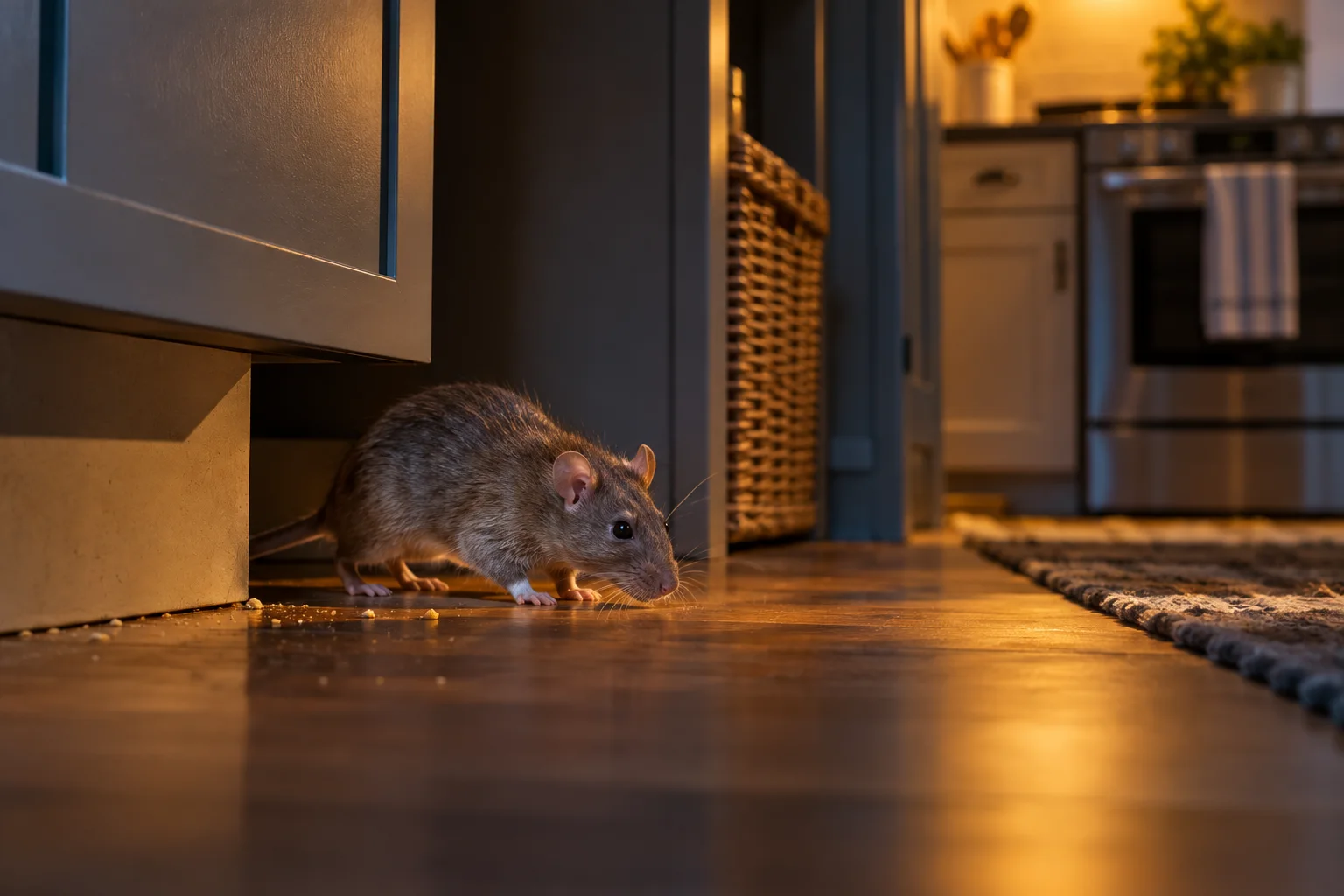
When a rat is inside a house, start by making the affected area easier to assess. Close interior doors when doing so does not trap a pet or create a safety issue, remove exposed food, and keep children and pets away from the place where activity was seen. Then record what supports the report: the time of a sighting, fresh droppings, chewed packaging, sounds, a trail along a wall, or an odor. A single sound inside a ceiling does not prove that the animal is directly above that room; framing, ducts, and plumbing can carry noise. Likewise, a droppings discovery can be old. The immediate objective is not to chase an animal from room to room. It is to preserve useful evidence, prevent food contamination, and identify which part of the house connects to the likely route. That makes later trapping and repair more deliberate and avoids spreading the problem into more accessible rooms.
Protect food and reduce indoor hiding places
Rats use cover and food opportunities while they explore a house. Put food, pet feed, and birdseed into containers that close securely, including items normally left in a pantry, garage, or utility room. Empty pet bowls after feeding, clean food residue from floors and appliance edges, and close garbage and recycling containers. Do not leave a pile of boxes against a wall while trying to determine where activity is occurring; clear a narrow inspection strip so wall edges, pipe penetrations, and appliance spaces can be checked. This does not require emptying the whole home. It means making the active zone visible. Do not move droppings or nesting material with a broom or vacuum. CDC advises wetting rodent contamination with a suitable disinfectant, allowing the contact time, and wiping it up with disposable materials. That method reduces the chance of stirring contaminated particles into the air.
Follow the route from interior signs to exterior access
Work from the evidence outward. In a kitchen, inspect behind the refrigerator, stove, sink cabinet, dishwasher, and utility penetrations. In a laundry room, inspect dryer vent connections, water lines, and gaps where pipes enter the wall. In a garage or basement, inspect lower door corners, storage edges, foundation openings, and connections to the living space. In an attic, inspect vents, eaves, roof transitions, and likely elevated approaches from trees or climbing vegetation without taking unsafe ladder or roof access. Then walk the exterior and compare the findings. UC IPM recommends sealing openings larger than one-quarter inch with rodent-resistant materials. The repair has to preserve the function of doors, vents, drainage, and appliances. Do not block a combustion vent, drain, weep path, or mechanical clearance because it looks like access. A suspected plumbing or electrical defect belongs with the appropriate trade.
Choose a removal method you can monitor
For active rats inside an occupied house, use a plan that can be checked. Protected traps placed along confirmed travel edges or near fresh signs can provide direct information when they are inspected regularly. Keep devices away from children, pets, and non-target animals, and do not place them where they obstruct exits or access to furnaces, panels, or other equipment. Log each check: location, whether a device was disturbed, whether bait changed, and whether fresh evidence appeared nearby. An untouched device is a cue to reassess placement, identification, competing food, or the possibility that activity has shifted. It is not proof that removal is complete. If poison is considered, follow the product label exactly. EPA notes that bait products must be kept away from children and pets. Indoor bait can also leave a carcass in an inaccessible wall or ceiling, so ask how that possibility will be monitored and handled before relying on it.
Time repairs so they solve access rather than shift it
Permanent exclusion should follow a coordinated decision about active animals. Closing one visible opening may redirect a rat to another gap, while closing all routes too early can leave an animal in a void. Document confirmed openings, likely openings, and areas that cannot be inspected safely. Use durable repairs suited to the surface: a fitted door sweep, securely fastened metal screening, flashing, or a proper repair around a service penetration. Foam alone is not a durable barrier where it can be chewed. If a one-way device is proposed, it should be fitted to a confirmed route, checked, and removed after the route is no longer active. Ask the provider to explain which openings will be closed immediately, which will remain under observation, and what evidence will determine that final closure is appropriate. That sequence is particularly important where the house connects to an attic, garage, crawl space, or shared wall.
Clean, verify, and keep the house less attractive
After removal and repairs, clean accessible contamination with the CDC approach rather than dry sweeping. Discard food and disposable packaging that appears contaminated. Evaluate porous materials such as cardboard, insulation, and nesting material individually; heavily contaminated material may need removal. Hard bins and surfaces can often be cleaned according to disinfectant directions. Continue checking the locations on the original map for new droppings, gnawing, sounds, or captures. Several checks without fresh signs after repairs are more convincing than one quiet night. If activity continues, return to the specific decision points: an overlooked exterior route, a failed repair, accessible food, moisture, clutter, or a poorly placed device. Maintain door seals, vent screens, waste lids, and food storage after the immediate problem ends. The goal is not merely to remove a rat from a room; it is to make the house difficult to enter and unrewarding to use again.