
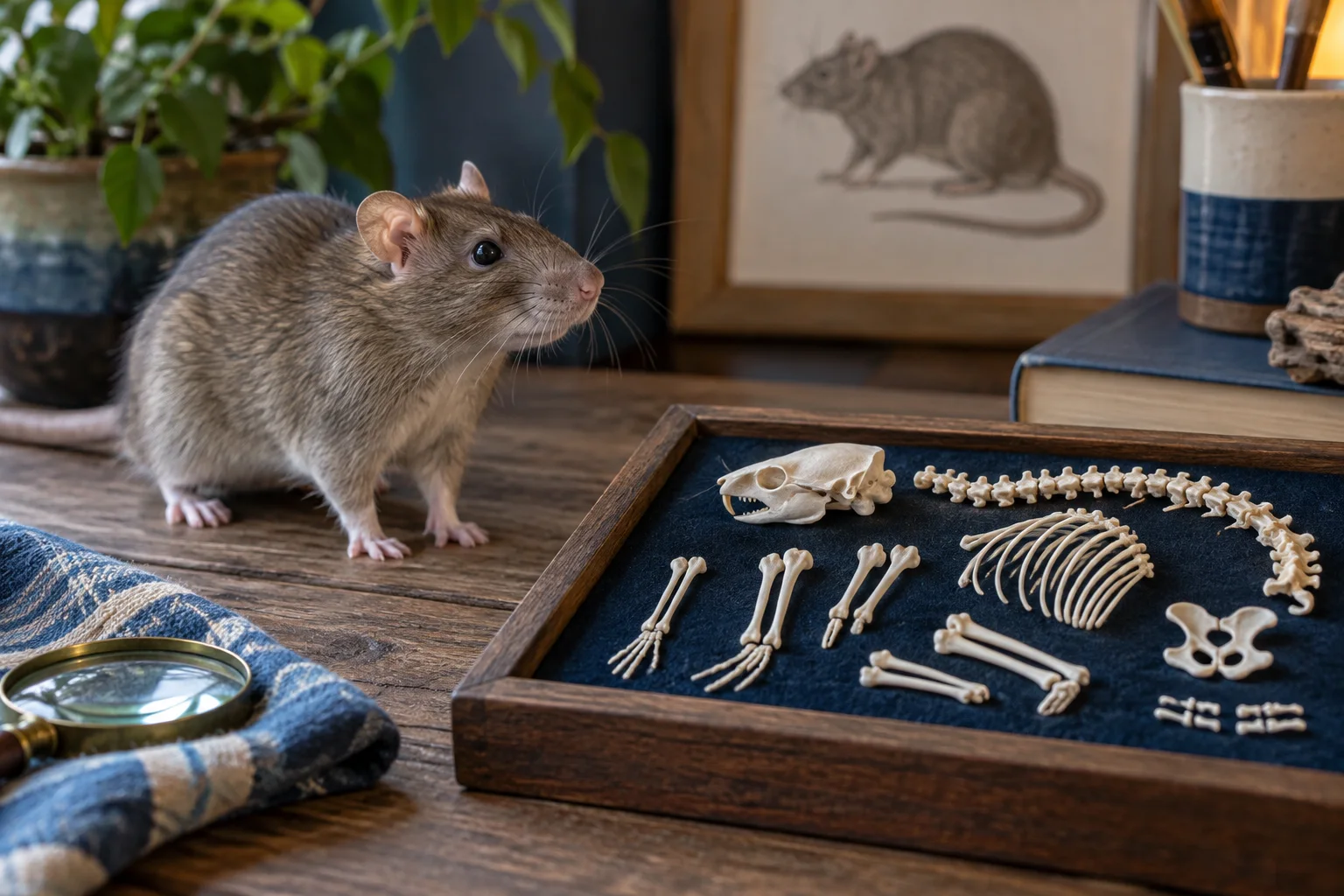
AI-generated illustration
Bones are an anatomy clue, not an infestation verdict
Finding small bones in a shed, crawlspace, garden, or garage can be unsettling. They may belong to a rat, but remains alone do not prove there is a current rat problem, identify the route an animal used, or show when it died. A predator may have carried a carcass in, a pet may have disturbed old remains, or decomposition may have exposed bones long after the animal was gone. Treat bones as a reason to inspect thoughtfully, not as a shortcut to a conclusion.
A skeleton is also less complete than people expect. Delicate parts disappear, scatter, or are obscured by soil and debris. Rodent bones can be confused with those of mice, squirrels, small birds, or other animals when seen one at a time. If identification would affect a health, wildlife, or property decision, use a qualified local resource. Do not build an answer around a single tooth, tail bone, or photo taken in poor light.
The skull carries the most recognizable features
A rat skull has a long facial portion, a distinct lower jaw, and prominent front incisors. Those incisors are a defining rodent feature: the rat anatomy reference in the National Library of Medicine describes incisors that continue growing and molars farther back in the mouth. A skull can therefore explain why gnawing is such an important rodent behavior, but it does not identify a specific bite mark on a wall or package by itself.
The head is not one solid lump of bone. It is a complex assembly that includes the jaw, facial bones, braincase, and tiny structures associated with hearing. That complexity helps explain why a crushed or partial skull can look unfamiliar. It also makes skull-based identification difficult for a homeowner. Size varies with age and species, and a missing jaw or damaged snout removes some of the features people rely on.
The backbone bends because it is segmented
A rat’s spine is made of many vertebrae running from the neck through the body and into the tail. Each segment joins its neighbors, allowing controlled movement along the body rather than making the animal a loose, boneless tube. The spine supports muscles and protects the spinal cord while permitting the bends that matter for running, turning, climbing, and fitting through an opening that the skull can pass through.
The popular claim that rats have no bones is simply wrong. Their flexibility comes from a mammal’s articulated skeleton, joints, muscles, and soft tissues working together. Cartilage is present in a living animal at particular joints and developmental areas, but it is not a replacement for the skeleton. A dry skeleton makes the distinction visible: the vertebrae, ribs, limbs, pelvis, and skull are all bony structures, while much of the soft tissue that helps movement has decomposed.
Ribs and limbs show an ordinary mammal plan
Behind the skull, a rat has ribs around the chest, a sternum at the front, shoulder structures, forelimbs, a pelvis, and hind limbs. The long bones of the limbs have familiar mammalian counterparts: an upper arm bone, paired forearm bones, a thigh bone, and lower-leg bones. This is why a separated limb bone can resemble a tiny version of a larger animal’s bone. Context matters more than a quick visual guess.
The hind limbs supply powerful movement, and the forelimbs are adapted for contact with the ground and object handling. None of that means a pile of bones tells you how a rat moved through your house. Bone shape describes anatomy; it does not map a travel route, reveal a nest location, or date an infestation. For those questions, look for current, location-specific evidence such as fresh droppings, new gnawing, tracks, or active sounds, and assess each sign carefully.
The tail is part of the skeleton
A rat’s tail contains a chain of small tail vertebrae. In intact remains, that chain can be long and obvious; in scattered remains, individual pieces may look like unrelated fragments. The tail is not a soft, boneless cord, and it should not be used as a simple measure for deciding that every small skeleton is a rat. Species differences, age, damage, and missing material can all mislead a casual comparison.
The gradual change from larger vertebrae near the body to smaller ones farther along the tail also shows why flexibility has limits. The animal can curve its body and tail, but the skull, rib cage, pelvis, limb joints, and linked vertebrae still set real boundaries. A rat does not flatten its skull or dislocate itself to pass through a hole. In practical terms, an opening that admits the head may be enough for the rest of the body to follow, depending on the animal and opening.
Do not handle wild remains with bare hands
Leave unknown remains alone until you can deal with them safely. CDC advises people not to pick up or touch dead wildlife with bare hands, and it recommends calling animal control for removal. The reason is straightforward: a carcass, its surrounding material, and the place where it was found can involve germs or other hazards. Keep children and pets away, avoid stirring dust or debris around the remains, and wash hands after any nearby cleanup work.
If you must document the find for a landlord, property manager, wildlife agency, or pest professional, take a photograph from a distance and record the location. That preserves useful context without turning the remains into a home identification project. Prioritize any current evidence in the same area, then decide on inspection or cleanup based on the whole picture. Rat skeletons are fascinating anatomy, but they are poor standalone proof of what is happening in a home today.