
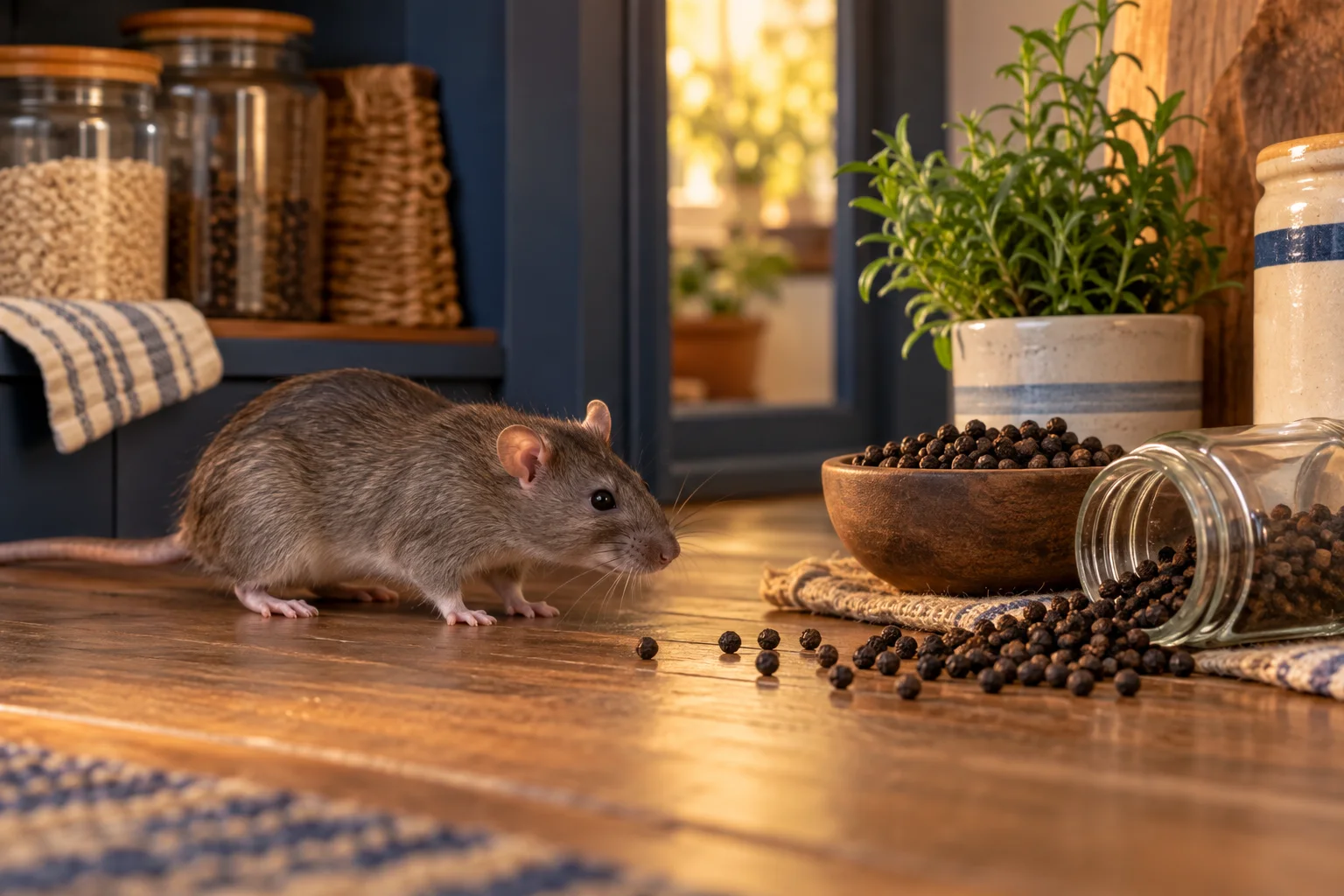
AI-generated illustration
Ground black pepper is not a reliable rat solution
Sprinkling kitchen black pepper around a suspected rat route is a popular home suggestion, but it is not a dependable way to remove rats or keep them out of a house. A rat may avoid a strong new smell briefly, ignore it, walk around it, or return after the odor fades. More importantly, pepper on the floor cannot close a gap, repair a burrow, protect food, or remove the shelter that brought the animal close to the building.
The practical answer is therefore no: ordinary ground black pepper should not be treated as a rat repellent with reliable household results. That is not the same as saying every pepper-derived substance has no biological effect. It means claims about a spice jar must be judged against the actual formulation, species, setting, concentration, and outcome studied. Those distinctions matter because online advice often turns a narrow laboratory or product claim into a promise that household pepper can clear an infestation.
Black pepper and black pepper oil are different things
Culinary pepper is a ground food spice. Black pepper oil is a distilled product from peppercorns with a different composition, concentration, and application method. The Environmental Protection Agency has described a registered black-pepper-oil active ingredient used in a granular animal-repellent product for specified non-food residential areas. The listed target animals included several mammals, but rats were not listed among them in that fact sheet.
That is useful context, not proof for a household rat claim. A registered product has a label, an intended use site, directions, and a defined formulation; loose powder from a kitchen does not become the same product when scattered around a baseboard. Follow the label for any pesticide product and do not improvise mixtures or use a product in a food-preparation area, inside a wall, or in a space the label does not cover. The product and setting control whether an evidence claim applies.
What the research actually shows
Studies of plant-based rodent deterrents are more nuanced than a simple yes or no. A published enclosure study examined odors of plant secondary metabolites with common voles and house mice. Black pepper oil appeared as part of some tested treatments, including combinations with other substances. The researchers reported species-specific results and called for further work on concentration and application methods. It did not test culinary pepper scattered in a home, and it did not establish a reliable rat-removal method.
That limitation is the key point. Animals may respond differently by species, and a result involving an oil, a particular concentration, a treated substrate, and a controlled food choice cannot be casually transferred to wild rats with access to a whole building. Even studies that find short-term avoidance can be useful for future product development without being a homeowner recipe. Evidence of a response is not evidence that a scent will block every route, overcome food access, or solve a nest inside a structure.
Why scent tactics fail around homes
A home gives a rat choices. If pepper is placed near one opening, a rat may use another gap, travel along a different edge, or reach food through a route you have not seen. Airflow, rain, cleaning, dust, and time also change how a smell behaves. A strong odor in one corner is not a sealed perimeter. This is why a scent-based approach often feels active while leaving the actual access problem untouched.
Pepper can also make inspection harder when it is scattered across a suspected runway or entrance. It changes the scene before you have documented fresh soil, tracks, droppings, gnawing, or an opening. If the pepper disappears, you still do not know whether it was disturbed by wind, moisture, pets, insects, people, or rodents. Start with evidence you can interpret. Photograph a suspected gap or burrow, examine nearby surfaces and food sources, and monitor for change without adding a confusing scent barrier.
Use physical exclusion for a physical problem
When a rat can reach a building through an opening, repair is more durable than a repellent. CDC recommends inspecting around foundations, vents, windows, doors, and the entries for utility lines. Its sealing guidance identifies durable materials for larger openings, including metal, cement, hardware cloth, and metal sheeting. The right material depends on the feature being repaired, but the principle is simple: an opening needs a sound, fitted repair rather than a smell placed nearby.
Work from the route outward. Find the gap or damaged screen, identify whether a burrow, vegetation, clutter, or utility penetration supports access, and fix the feature in a way that still allows necessary drainage and ventilation to function. Do not pack a vent, drain, or utility opening with pepper. If you cannot determine how the animal is entering, or access is behind finished walls, in a crawl space, or around active utilities, an inspection by a qualified professional is a better next step than repeated applications of a household spice.
Make the area less rewarding
Pepper does not change the reasons rats remain nearby: available food, water, shelter, and a usable route. Secure garbage in containers with intact, tight-fitting lids. Put away pet food after use, clean spills, store feed and pantry goods in suitable closed containers, and reduce ground-level clutter and dense cover near the house. These steps are not a magic trick, but they remove the benefits that make an inconvenient route worth revisiting.
This approach also gives you a way to judge progress. After repairs and cleanup, check for fresh droppings, new gnawing, reopened openings, or tracks in the same locations. If activity continues, the remaining evidence can guide the next inspection. With pepper, it is easy to keep refreshing an odor without learning anything. With exclusion and sanitation, each observation helps reveal whether an entry point, food source, or shelter condition still needs attention.