
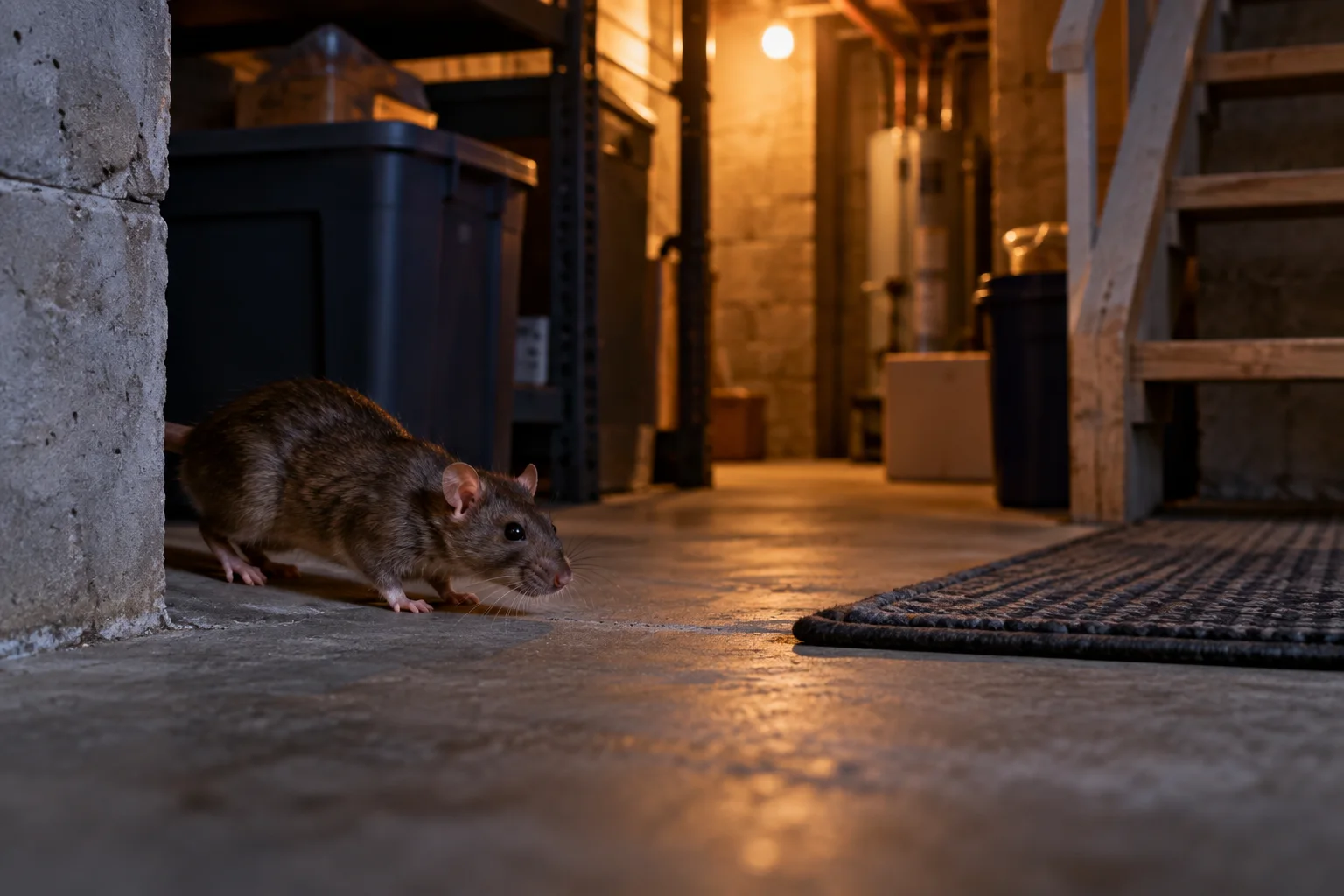
AI-generated illustration
Start with a basement map, not a trap
A basement can hold signs from several different periods, so begin by separating fresh activity from the history of the room. Walk the perimeter before moving boxes. Note droppings, gnawing, food damage, rub marks on pipes or walls, disturbed insulation, odor, and the exact places where sounds were heard. Mark the findings on a sketch that includes foundation walls, stairs, utility equipment, floor drains, and storage. This is more useful than assuming that a sound over one ceiling tile identifies the animal's location; framing and ducts carry sound. Check whether signs cluster at the lower wall, beside a pipe chase, near a drain, or at the rim joist where the house framing rests on the foundation. A cluster gives the inspection a direction, not proof of an entrance.
Inspect moisture and outdoor pressure
Basement conditions often make a property attractive before a rat reaches the finished area. Look for a leaking hose bib, wet soil beside the foundation, overflowing gutters, downspouts that discharge next to the wall, an unsealed bulkhead door, wet cardboard, or a sump area with standing water. Correcting moisture does not remove rats by itself, but it reduces a reason to stay near the building and helps preserve repair materials. From outside, inspect basement windows and wells, foundation penetrations, door corners, vent covers, and gaps around utility lines. Also look for burrows under clutter, garbage cans, decks, shrubs, or woodpiles. UC IPM notes that Norway rats commonly use ground-level areas and burrows, while roof rats may use elevated routes, so the exterior review should include both the foundation zone and routes that connect it to other portions of the house. Keep observations separate from conclusions: a burrow near a wall needs investigation, but it is not permission to start digging against the foundation or sealing drainage details.
Treat pipe gaps and rim joists as building details
Pipes, cables, ducts, and conduits often pass through a basement wall or rim joist, and trim can hide a larger gap behind it. Inspect these penetrations closely with good light, but do not alter an active electrical, gas, water, drain, combustion, or HVAC component simply to close an opening. The repair needs to match the assembly. A gap at a pipe sleeve may require a durable rodent-resistant backing and a sealant suitable for the surface; a damaged rim-joist area may also need repair of wet or decayed framing. Foam by itself is usually a poor answer where it can be chewed or pulled out. UC IPM recommends sealing openings larger than one-quarter inch with appropriate materials such as metal screening or sheet metal. That guidance does not mean covering every opening: weep paths, combustion vents, appliance clearances, and required drainage must keep their intended function. If the suspected route involves a failed cleanout, broken pipe, or other plumbing defect, involve a plumber rather than improvising a seal.
Do not mistake a floor drain for a diagnosis
A floor drain can raise understandable concerns, but it should not be treated as proof that rats are coming from the sewer. First look for evidence around the drain itself and in nearby wall or utility spaces. Check whether the drain is functioning, whether it has a cover designed for that installation, and whether there are signs of a plumbing problem such as backup, damaged piping, or an open cleanout. Never pour chemicals into a drain, block it, or remove plumbing components as a rodent-control experiment. Doing so can create a sanitation or flooding problem without closing any access route. A licensed plumbing professional can assess a damaged drain, trap, cleanout, or sewer concern and advise on repairs that retain proper drainage. Meanwhile, keep the surrounding floor clear enough to inspect and do not store food, pet feed, or damp cardboard beside it. The useful question is whether the drain is part of an actual access route, not whether it merely exists in the same room as rat activity.
Use removal methods that stay accessible
A basement offers protected places for monitored control, but devices should never be placed where they cannot be checked or where they interfere with furnace, water-heater, electrical-panel, or service access. Clear a narrow working path along affected walls and behind storage so evidence and devices remain visible. If trapping is used, place protected devices along confirmed travel edges or near fresh signs, keep them out of reach of children and pets, and check them on a written schedule. A capture provides information about the location and timing of activity; it does not establish that every entry point is closed. Be cautious about relying on poison indoors. EPA advises using rodent bait products only as directed and keeping them away from children and pets. A poisoned animal can die in a wall, ceiling, or insulated chase where removal is difficult. If bait is part of a professional plan, ask where stations will be placed, who will inspect them, how carcasses will be retrieved, and what will trigger a change in method.
Finish with cleanup, repair, and verification
After active control begins, clean accessible contamination carefully. CDC advises against sweeping or vacuuming dry droppings, urine, or nesting material because this can stir contaminated particles into the air. Wear gloves, wet the material thoroughly with an appropriate disinfectant, allow the stated contact time, then remove it with disposable towels before cleaning hard surfaces. Evaluate cardboard, porous insulation, and nesting material separately; heavily contaminated material may need removal rather than surface treatment. Once confirmed routes are addressed with durable repairs, reorganize basement storage so boxes do not form an uninspectable wall against the foundation. Use bins, secure pet feed, and correct leaks promptly. Continue checking the original map for fresh signs. Repeated checks without fresh signs are stronger evidence than one quiet night. If activity persists, reassess the route and completed repair. A durable basement solution preserves drainage and equipment access while making the room less useful to rats.